Showing posts with label crowdsourcing. Show all posts

Friday, June 28, 2013

As Predicted...

As predicted in Exploiting Pinterest's Embed Feature, semi-automated or fully automated scraper sites are re-arranging Pinterest's crowdscraped content for further redistribution but especially PROFIT.

May this serve as a reminder for those that are flattered when their material is "pinned" - when the horses run out of the barn, there is no telling how far they'll go.

To wit: craftprojectimage.com.

Every content creator's favorite byline is displayed on this scraper blog:
No copyright infringement intended. The source of each image and it's related text is always linked to with the 'source' link at the bottom of each post.
Except that the "source link" leads back to Pinterest, not to the content provider's own website.

And the below, a reminder for everyone that argues that "Pinterest makes no money!!!":
This website uses third-party advertising companies to serve ads to visitors of this site and may use information (not including visitors' name, addresses, e-mail addresses, or telephone numbers) about visits to this website to provide ads which are of interest to the visitors. It is advised to install a dependable anti-virus software and firewall on visitor's computer so as to have optimum safety from computer virus attacks.
Pinterest may make no money beyond raising venture capital by exploiting other people's content by way of crowdscraping, but there is nothing to stop fourth-party scraper sites to exploit the EMBED feature and actually profit from copyright infringement.

The "flattery" of having one's artistic material ravaged by pinners comes at the cost of being used a tool by internet pirate to draw visitors, and infect their computers.

Monday, October 22, 2012

A Crowdsourced Censorship Board


The new censorship flag crowdsources content policing
and will stroke some much needed drama.


Pinterest is not satisfied with being a crowdscraper of third-party content.

Pinterest is now crowdsourcing the censorship of "offensive content" uploaded by its users, to its users.

Pinterest users are not just unpaid scrapers, and a legal shield; they are now Pinterest's censorship board.

Pin Hags can now bitch and moan to Pinterest about the following offenses to their sensitbility:
  • Nudity or Pornography
  • Attacks a group or Individual
  • Graphic Violence
  • Hateful Speech or Symbols
  • Actively promotes self-harm
  • Spam
  • Other

According to PC Mag, and on the plus side, the drama is bound to erupt:
Blocking someone will prevent you and the other person from being able to follow each other's boards, as well as like, repin, or comment on each other's pins.

Friday, September 28, 2012

I Will Crowdscrape


I Will Crowdscrape

Pinterest, I love you
You give me many likes
You give me followers
From lawsuits, I shield you
I'll bite the legal bullet
And run the gauntlet

Pinterest, I love you
You line up pictures
You host my folders
From artists, I steal for you
Master, are you pleased?
I serve, so you be enriched.

Wednesday, September 26, 2012

Soon, The Dough Will Roll In

Tim Peterson, in Pinterest's Money Play Could Hinge on Its Meme-Laden Data Social - site rounding up its options, reports that:
Last week Pinterest met with ad tracking and attribution firm Convertro to discuss available monetization opportunities.
The day Pinterest monetizes that scraped third party content will be a game changer.

From the perspective of the volunteer scrapers the sight of advertisement, regardless of the form it takes, Pinterest's "share" motto will be tainted by the "profit" imperative.

Saturday, September 22, 2012

Crowdscraping

Why are we referring to Pinterest as a crowdscraper?

"Scrapers" were once considered the #1 scourge of the internet. Automated scripts would crawl the web for topical content and images from third party websites, collage it together without sense or logic, slap ads on it, and voilĂ ! A mish-mash website is created, honed with automated search engine optimization trickery, and acts like a honey pot to draw search engine traffic and befuddled visitors, who hopefully will befuddledly click on the advertisements. Most of the time, visitors walked away at the first sight of the bizarre, keyword-stuffed, content-less gibberish that made scrapers instantly recognizable.

Search engineers would work hard to weed out this nuisance out of their result pages. They hired linguistics experts to find ways to distinguish normal syntax from robot word salad.

They also strove to ferret out duplicate content, and set out to find ways to distinguish the copiers from the originators.

The ever-inventive scrapers responded by hiring English-speaking "writers" from the third world with no actual understanding of the topic beyond some ability to concoct stock, sensical sentences such as: "Everyone loves dolphins. Dolphins are important to the world. Without dolphins, there would be no dolphins, etc."

Welcome to the next generation of content scraping: crowdscraping.

There is no doubt that Pinterest is a content scraper.
  • Nearly all its content is directly taken from other websites.
  • Stolen content is collaged and re-organized.
  • No original content anywhere.
  • Sophisticated search engine optimization techniques geared towards massive traffic draw to itself (giving no credit to the links to the original websites with nofollow attributes).
Instead of bots, or third-world manpower requiring salaries, Pinterest has enlisted volunteer scrapers. These volunteers serve two key purposes: (1) scrape content for Pinterest and (2) act as a legal human shield, taking the hit of C&D demands for damages while Pinterest has made itself legally untouchable via its TOU.

The volunteers' reward? Completely meaningless "Likes," "Repins" and "Followers" from complete strangers, which are like catnip to the social animals that we are.

Yet, Pinterest barely qualifies as a social medium. Most social media, even those that are plagued by a fair amount of infringement, have the merit of having been designed as a means of original self-expression. Despite Pinterest's marketing claims that the pictures we like or the images of things we would buy if we had the money are "self-expression," they are in fact the expressions of others.

OTHER PEOPLE'S STUFF ≠ WHO I AM


We can only hope that this will dawn on pinners, that Google will penalize the practice, and that crowdscraping will be but a passing fad.

Tuesday, September 11, 2012

Pinterest Deflates Again

...all of that hype never seems to fully drown out the hum of online merchants telling us that, despite the hours and hours of time they spend on Twitter, Facebook or Pinterest [...] marketing their sales, the returns are negligible.
When content providers decide to compromise their copyright by allowing their content on Pinterest, or even posting it themselves, they do so with the expectation of some measure of promotion of their product or website, or better yet, sales.

Pooling data from 5 anomymous online marketplaces, David Steiner, writing for EcommerceBytes reveals dismal referral traffic from Pinterest, Facebook and Twitter.

The much-hyped "Pinterest high conversion rate" suffers a devastating blow:
Twitter had only a quarter of Pinterest's traffic, the quality and conversion rate was about double that of Pinterest
CornerstoneConsultingInc reports that:
...according to Bloomberg, the data found that Pinterest facilitates buying, but only to a relatively unimpressive extent. An average Pinterest purchase came out to $.75 as contrasted against $2.08 per order from Facebook referrals and $33.66 from Twitter.
In view of these statistics, coupled with the standard NOFOLLOW attribute link scheme of most of the crowdsourced scrapers, there is very little to gain by allowing Pinterest to re-distribute your content, and possibly more to lose in the long run as you lose sight of where your intellectual property ends up.

Monday, September 3, 2012

Ehow's Spark; Undetectable, Unstoppable.


Meet the deadliest, stealthiest crowdsourced content scraper yet;
Ehow.com's Spark.


"Pinnablebusiness.com" - a website devoted to uncritical fawning over Pinterest - warns us all about the evil new crowdsourced content scraper at ehow.com called Spark.

The author gushes about Pinterest to an extent that even the negatives are spun into tiny silver linings.
When Pinterest outranks you for your own content, it can be a good thing if you would otherwise not rank on page one or two of search engine results for a particular search phrase.
I recommend reading of the whole article if only to chuckle at the contradictions of Pinterest=good and Spark=bad for doing the same thing.

The author is right in that this new entity makes Pinterest look like a children's choir. Ehow's Spark is entering the content scraping field like a nuclear pirate ship sailing into a koi pond. Isn't this quote from their TOS positively terrifying?
...you hereby grant eHow a worldwide, royalty-free, freely transferable, freely sublicensable (through unlimited levels of sublicense), non-exclusive license to use, reproduce, modify, transmit, distribute, publicly perform and display (including in each case by means of a digital audio transmission), and create derivative works of the User Generated Content, in any form, media, or technology now known or later developed. You also hereby waive any moral rights you may have in such User Generated Content under the laws of any jurisdiction. You hereby appoint us as your agent with full power to enter into and execute any document and/or do any act we may consider appropriate to confirm the grant of rights, consents, agreements, assignments and waivers set forth in these Terms. You agree that we may (but are not obligated to) display your User Generated Content, and your user name or your actual name (according to the preferences you select at the time that you register) along with your User Generated Content.
Waiving moral rights? MORAL RIGHTS? And user-generated content? No... this is scraped third-party content, let's call a spade a spade. Ironically, ehow is particularly protective of "its" content:
Site on your computer for your own personal, noncommercial purposes. eHow reserves all other rights in the content on the Site, on its own behalf and the behalf of its licensors (including contributors), and eHow does not, directly or by implication, by estoppel or otherwise, grant any other rights or licenses to you under these Terms. Except as expressly stated in this paragraph, you may not reproduce, distribute, modify, publicly perform or display, or prepare derivative works of any content on the Site without prior written consent from eHow or the third-party owner of the rights in that User Generated Content (if any).
You can find further horifying details from Ehow's Terms and Conditions here.

And now from some obligatory cutesy lingo: Spark users aren't pinning; they aren't loving; they are clipping.

Scraping from Google Images is expressly encouraged.
Looking for inspiration?
Search Google Images
Spark's links are straight up, worthless nofollow links.

For maximum intrusion of your privacy, users can only login with Facebook or Google. The Spark people aren't playing; this is business.

All that infringed content is kitted up with a convenient PIN IT button to help the infringement spread like wildfire.

Their "pinmarklet" is a very, very special copyright infringement tool. Raise your glass to real innovation; it grabs the text, too, and the text's formatting. Crowdsourced copyright infringement without the boundaries.

On the go? Ehow's Spark wasted no time providing the volunteer content scrapers a mobile app:


Lo and behold, we do have yet another proprietary blocking tag to add to our collection in our ever swelling header field:

<meta name="ehow" content="noclip" />

In order to test how to best block Spark sitewide with .htaccess (image substitution is so much fun!), I have compromised my privacy and created a test account with Spark. I "clipped" images from my own websites, and examined my logs. It is with great alarm and astonishment that I must report ehow.com's Spark to be UNDETECTABLE, and therefore UNSTOPPABLE by any means other than their arrogant opt-out meta-tag. They might be accessing the images from what is already uploaded to the user's browser, rather than from the creator's website servers.

The worst one yet. And still... the very worst has probably yet to come.

Sunday, August 26, 2012

Copyright Infringement Is A Contagious Disease

There is now a blog (pinterestrends.blogspot.com) that is apparently devoted to scraping content from Pinterest, the popular crowdsourced content scraper, with the infuriating disclaimer below:
All the items posted on this blog were found on Pinterest, and the copyright of each remains with its originator. If you are the owner of an image and you want remove it, please contact bicyclenthusiast [at] gmail.com
Further investigations reveal that the blog uploads the images from Pinterest to the blogspot servers, and doesn't link to either the Pinterest page or the original source. Further, the text is unashamedly infringing on other websites; this "blog" is part scaper, and scraper of scraper.

Wednesday, August 22, 2012

You've Been Crowdsourced

There is a new word in the dictionnary!

Crowdsourcing.

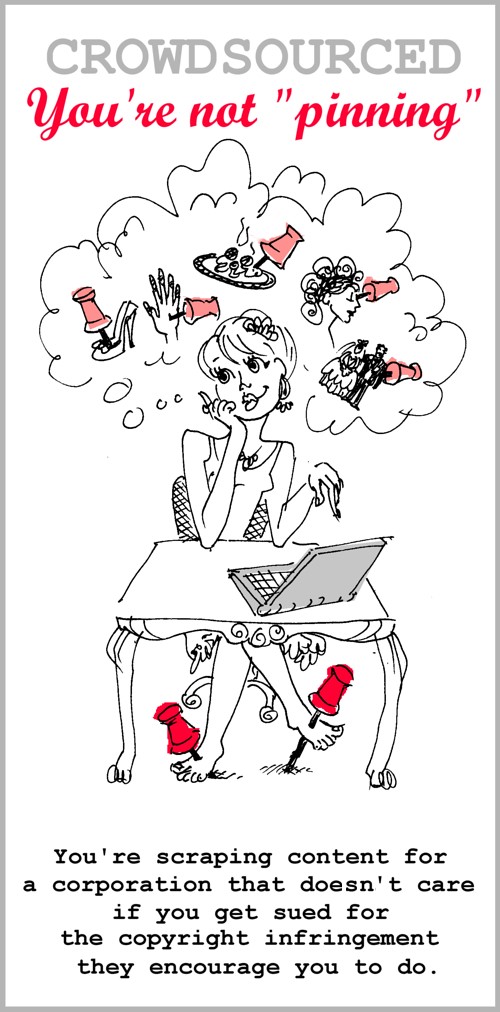
To make a sentence, Pinterest is crowdsourcing the scraping of third party content and the responsibility for the resulting copyright infringement to its obsessed, compulsive users.

pinterest