It's October already and we've been exploring the conflict between the crowdscraper Pinterest and the content creators who suffer the scraping since May. Today, we're pausing to look at the big picture.
Once a robust tool to support faster and better creative outputs, computers have now devolved into perma-obsolescing digital consumption platforms.
It wasn't so long ago that computers revolutionized how we type, archive, and design; machines were welded to every work desk. Some of us may even remember some warnings about how anyone not proficient with PASCAL or COBOL programming languages would be unemployable. The internet became a repository for volunteered information, a virtual encyclopedia of human knowledge and pursuit.
Would there come a time where there the marginal value of an extra bit of information on the web would approach zero, and we'd just piss time away re-arranging and re-exploiting what is already there and accessible? We would have hoped not.
On the other end of what has become a spectrum, cell phones, after a bout of getting smaller, started to get smarter.
For a while we fumbled and put tiny keyboards on cell phones, but by and large, the tendency is to drop the keyboard. With this trend, written communications reached unprecedented brevity (think: Twitter). Their worth diminished, and the time invested in each communication suffered a similar fate.
Laptop keyboards aren't particularly ergonomic, and don't get much love. The touchscreen tablet was born.
Technology has progressed in a way that has led us down the path of least resistance. Instead of using computers to create, build, and transform, our hands firmly on the mouse and the keyboard, we are now consuming farmvilles, images, illegal music downloads, youtube pratfalls and social rewards such as likes and followers. It must be depressing for microprocessors these days. Like The Hitchhiker's Guide robot Marvin, brain the size of a planet, reduced to performing menial tasks like fetching meek, cooperating ship intruders.
This is where Pinterest fits in. Scroll with your index, press the pinmarklet, and you've scraped content for Big Brother. You moved some electrons, re-arranged some zeros and ones off a big server somewhere, and completely wasted your time. Each like represents one unit of someone acknowledging your existence from the anonymous time-wasting masses, and the illusion that you're doing something worthwhile. It's an illusion. Pinning is doing nothing. Absolutely nothing.
Someday, when the pinners from the Pinner Hall of Shame are laying in their coffins, the survivors will say, in their obituraries: "she pinned a lot of pictures on the internet." And the kids will laugh, because there may be no internet left to speak of, abandoned the same way computer punch cards once were. "What's the internet, mom? Is it what you used before we switched to the stratocube?"

Showing posts with label pinmarklet. Show all posts
Showing posts with label pinmarklet. Show all posts
Thursday, October 4, 2012

Monday, September 3, 2012
Ehow's Spark; Undetectable, Unstoppable.

Meet the deadliest, stealthiest crowdsourced content scraper yet;
Ehow.com's Spark.
"Pinnablebusiness.com" - a website devoted to uncritical fawning over Pinterest - warns us all about the evil new crowdsourced content scraper at ehow.com called Spark.
The author gushes about Pinterest to an extent that even the negatives are spun into tiny silver linings.
When Pinterest outranks you for your own content, it can be a good thing if you would otherwise not rank on page one or two of search engine results for a particular search phrase.I recommend reading of the whole article if only to chuckle at the contradictions of Pinterest=good and Spark=bad for doing the same thing.
The author is right in that this new entity makes Pinterest look like a children's choir. Ehow's Spark is entering the content scraping field like a nuclear pirate ship sailing into a koi pond. Isn't this quote from their TOS positively terrifying?
...you hereby grant eHow a worldwide, royalty-free, freely transferable, freely sublicensable (through unlimited levels of sublicense), non-exclusive license to use, reproduce, modify, transmit, distribute, publicly perform and display (including in each case by means of a digital audio transmission), and create derivative works of the User Generated Content, in any form, media, or technology now known or later developed. You also hereby waive any moral rights you may have in such User Generated Content under the laws of any jurisdiction. You hereby appoint us as your agent with full power to enter into and execute any document and/or do any act we may consider appropriate to confirm the grant of rights, consents, agreements, assignments and waivers set forth in these Terms. You agree that we may (but are not obligated to) display your User Generated Content, and your user name or your actual name (according to the preferences you select at the time that you register) along with your User Generated Content.Waiving moral rights? MORAL RIGHTS? And user-generated content? No... this is scraped third-party content, let's call a spade a spade. Ironically, ehow is particularly protective of "its" content:
Site on your computer for your own personal, noncommercial purposes. eHow reserves all other rights in the content on the Site, on its own behalf and the behalf of its licensors (including contributors), and eHow does not, directly or by implication, by estoppel or otherwise, grant any other rights or licenses to you under these Terms. Except as expressly stated in this paragraph, you may not reproduce, distribute, modify, publicly perform or display, or prepare derivative works of any content on the Site without prior written consent from eHow or the third-party owner of the rights in that User Generated Content (if any).You can find further horifying details from Ehow's Terms and Conditions here.
And now from some obligatory cutesy lingo: Spark users aren't pinning; they aren't loving; they are clipping.
Scraping from Google Images is expressly encouraged.
Looking for inspiration?Spark's links are straight up, worthless nofollow links.
Search Google Images
For maximum intrusion of your privacy, users can only login with Facebook or Google. The Spark people aren't playing; this is business.
All that infringed content is kitted up with a convenient PIN IT button to help the infringement spread like wildfire.
Their "pinmarklet" is a very, very special copyright infringement tool. Raise your glass to real innovation; it grabs the text, too, and the text's formatting. Crowdsourced copyright infringement without the boundaries.
On the go? Ehow's Spark wasted no time providing the volunteer content scrapers a mobile app:

Lo and behold, we do have yet another proprietary blocking tag to add to our collection in our ever swelling header field:
<meta name="ehow" content="noclip" />
In order to test how to best block Spark sitewide with .htaccess (image substitution is so much fun!), I have compromised my privacy and created a test account with Spark. I "clipped" images from my own websites, and examined my logs. It is with great alarm and astonishment that I must report ehow.com's Spark to be UNDETECTABLE, and therefore UNSTOPPABLE by any means other than their arrogant opt-out meta-tag. They might be accessing the images from what is already uploaded to the user's browser, rather than from the creator's website servers.
The worst one yet. And still... the very worst has probably yet to come.
Saturday, September 1, 2012
Unrequited Love At Loveit.com

Pinterest is little more than a dumb platform based on crowdsourcing the scraping of visual content without having to pay anyone a cent, except perhaps a handful of lightweight programmers and high-power attorneys; it was simply a matter of time for other crowdsourcing content scraping thieves to start to elbow it for a piece of the action. Pinterest, for a time, was ahead of the game by providing a central display of third-party image content, which was until then scattered on the creators' websites. With many viable competitors now entering the arena, the visual content is now trending back to its original scattered state, only on image scrapers rather than the creators' own websites. Yes, this is ironic.
Launched in mid-May 2012, Loveit.com is such a viable competitor. It outshines Pinterest in terms of sheer arrogance.
Mashable quoted LoveIt’s CEO Ron Lapierre:
We clearly call out in our Terms of Service that the content you bring into LoveIt is yours…We don’t claim any ownership of the content and you’re more than welcome to move it or share it on any other site you choose.Yeah, right. Just like Pinterest, they have a one-click infringement pinmarklet-like tool which is called +Loveit - blowing any pretense that Loveit isn't just yet another copyright infringement platform right out of the water. It's just a variation of the no copyright infringement intended disclaimer.
- Loveit.com shows large "thumbnails" at 220 pixels wide.
- For now, unlike Pinterest, Loveit's links to your website are normal links, and not rendered worthless by the addition of the "nofollow" attribute. This may be a temporary lure, until they can legitimately use spam prevention as an excuse to use the "nofollow."
- Loveit.com's domain name is cloaked by a privacy service. One cannot investigate ownership of the website by normal means.
- With Loveit.com, you can select all images on a given page - copyright infringement on steroids!
- Image uploads from search engine result pages are welcome as always.
- With Loveit.com, you can upload multiple files from your hard drive.
- Like Pinterest, Loveit has an EMBED code generator to propagate the infringement to fourth-party websites.
- Loveit.com has private/group settings making the infringement more difficult to detect.
- That's not all! There's a PIN IT button on every image uploaded to Loveit.com!!! The copyright equivalent of the multiplication of loaves and fish.
- Guess what? Like Pinterest, it's hosted on Amazon's servers! Indeed, their abuse contact email is at: ec2-abuse@amazon.com.
- Loveit.com, perhaps wishing to make a user's transition from crowdsourcing for the ultimate benefit of Ben Silbermann and his venture capitalists, to its own benefit, "a frictionless experience" has a tool to faciliate mass transfer of images from Pinterest to itself.
- Like Pinterest, Loveit features "/source/" subfolders where the aggregated content from a single website is displayed. There is a large one for Pinterest: http://loveit.com/source/pinterest.com. Like Pinterest, further pages of aggregated content can be acessed at http://loveit.com/source/pinterest.com?page=2 and changing the page number in the URL. Of course, the reciprocate page of loveit.com content aggregated at Pinterest can be found at http://pinterest.com/source/loveit.com
Learning from Pinterest's errors, Loveit comes right out of the gate with an opt-out code.
As was predicted; now, every Pinterest clone is going to have a proprietary blocking code, forcing everyone to recode their websites, and creating a culture of "free-to-steal" as the default state. And look at the pulling of heartstrings: this blocking code is called "nolove." <meta name="LoveIt" content="nolove">. Right. Thanks, but no thanks. No one should have to do this for what is bound to become hundreds of websites.
The recoding-for-every-new-copyright-infringement-platform insanity does not stop here. You can block individual images with yet another propriety attribute to insert in the img src code: nolove="nolove" - again, aw shucks, don't you want love? No? You want no love? No love for this poor unloved image.
There is a way out of this madness with your .htaccess file. Image substitution is more complicated than with Pinterest, because Loveit.com sneakily fails to identify itself in the user-agent field. Instead, you have to deny access to all of Amazon's cloud server IP ranges. There is no downside to this, there is no legitimate traffic to be received from an Amazon cloud server.
Add the following at the top of your .htacess file:
ErrorDocument 403 http://farm9.staticflickr.com/8445/7895057430_928a6c1171_b.jpgAdd this last in your .htaccess file:
Allow from allThis will substitute any unwanted love for this image:
order allow,deny
allow from all
Deny from 8.18.144.0/23
Deny from 23.20.0.0/14
Deny from 46.51.128.0/17
Deny from 46.137.0.0/16
Deny from 50.16.0.0/14
Deny from 50.112.0.0/16
Deny from 54.240.0.0/12
Deny from 67.202.0.0/18
Deny from 72.44.32.0/19
Deny from 75.101.128.0/17
Deny from 79.125.0.0/17
Deny from 96.127.0.0/17
Deny from 103.4.8.0/21
Deny from 107.20.0.0/14
Deny from 122.248.192.0/18
Deny from 174.129.0.0/16
Deny from 175.41.128.0/17
Deny from 176.32.64.0/18
Deny from 176.34.0.0/16
Deny from 177.71.128.0/17
Deny from 184.72.0.0/15
Deny from 184.169.128.0/17
Deny from 204.236.128.0/17
Deny from 216.182.224.0/20

Wednesday, August 22, 2012
You've Been Crowdsourced
There is a new word in the dictionnary!
Crowdsourcing.
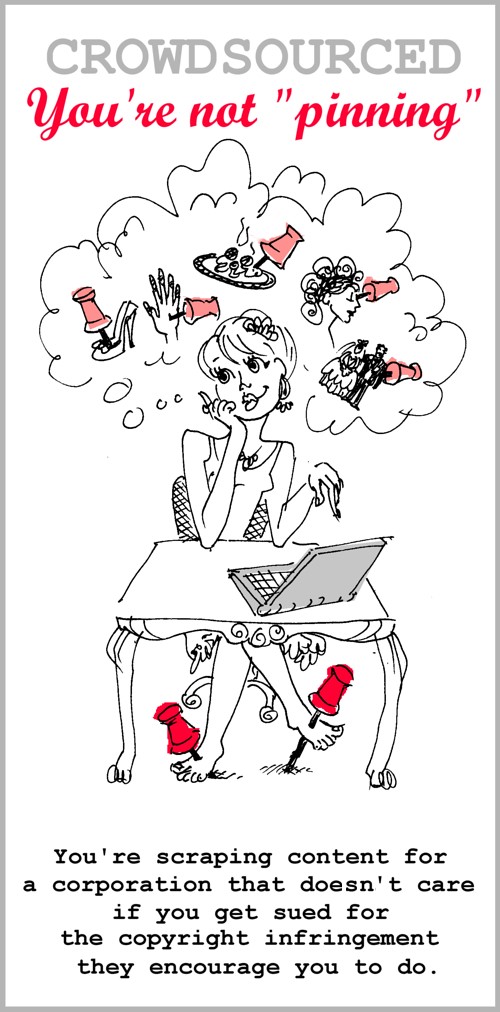
To make a sentence, Pinterest is crowdsourcing the scraping of third party content and the responsibility for the resulting copyright infringement to its obsessed, compulsive users.
Crowdsourcing.
To make a sentence, Pinterest is crowdsourcing the scraping of third party content and the responsibility for the resulting copyright infringement to its obsessed, compulsive users.
Friday, June 22, 2012
B-I-G D-E-A-L
So. In Pinterest Gives Copyright Credit to Etsy, Kickstarter, SoundCloud, we find out that Pinterest is making some "effort" to give un-editable attribution to some big corporate friends.
BIG.
DEAL.
These corporate friends are Etsy, a well-known online craft bazaar, Kickstarter, a funding platform that's probably just a publicity-hog anyway, and SoundCloud, a music-sharing website that allows a pinner to "pin" actual songs to their pinboard, with copyright-infringement issues of its own (see this article, although they are reputed to be meticulously pro-active in their infringement detection, quite unlike Pinterest).
Just like when Pinterest removed the word "sell" from their Terms of Use, and rolled out the arrogant nopin metatag that turned copyright on its head as something that doesn't exist for Pinterest until you recode all your thousands of static pages (in some cases) to affirm your copyright against their users, this is another completely useless news report that gives the appearance that Pinterest is making some progress on the respect-copyright front when it is doing nothing at all, as usual.
Attribution doesn't absolve copyright infringement.
Halting copyright infringement may not even be on Pinterest's agenda. This may be due to Pinterest's very existence and popularity appearing to be entirely derived out of the feverish infringement binge of its users, enabled by the convenient pinmarklet.
One cannot be surprised that when Pinterest makes headlines about copyright, it's not even about copyright. It's just more smoke and mirrors to coddle its users into thinking they're working really hard for us creators, and to seat copyright infringement on the thrones of angels.

Attribution is necessary, but over-rated.
The "money" rests in distribution, not fame.
BIG.
DEAL.
These corporate friends are Etsy, a well-known online craft bazaar, Kickstarter, a funding platform that's probably just a publicity-hog anyway, and SoundCloud, a music-sharing website that allows a pinner to "pin" actual songs to their pinboard, with copyright-infringement issues of its own (see this article, although they are reputed to be meticulously pro-active in their infringement detection, quite unlike Pinterest).
Just like when Pinterest removed the word "sell" from their Terms of Use, and rolled out the arrogant nopin metatag that turned copyright on its head as something that doesn't exist for Pinterest until you recode all your thousands of static pages (in some cases) to affirm your copyright against their users, this is another completely useless news report that gives the appearance that Pinterest is making some progress on the respect-copyright front when it is doing nothing at all, as usual.
Attribution doesn't absolve copyright infringement.
Halting copyright infringement may not even be on Pinterest's agenda. This may be due to Pinterest's very existence and popularity appearing to be entirely derived out of the feverish infringement binge of its users, enabled by the convenient pinmarklet.
One cannot be surprised that when Pinterest makes headlines about copyright, it's not even about copyright. It's just more smoke and mirrors to coddle its users into thinking they're working really hard for us creators, and to seat copyright infringement on the thrones of angels.
Attribution is necessary, but over-rated.
The "money" rests in distribution, not fame.
Friday, June 8, 2012
Safe Harbor And The Pinmarklet

The pinmarklet is a gateway to easy copyright-infringement.
Pinterest says so.
Once installed in your browser, the “Pin It” button lets you grab an image from any website and add it to one of your pinboards. When you pin from a website, we automatically grab the source link so we can credit the original creator.Not a single word educating the users about copyrights, or how to find images from the creative commons. Users are entreated to GRAB ANY IMAGE from ANY WEBSITE. That's it! Pinterest even implies that's it's OK since they are crediting the originator.
Can Pinterest hide behind the safe harbor provision while giving its users a tool to infringe on copyrights, telling its them outright to go forth and use it for illegal activity?
If a user were to be sued for copyright infringement, could turn back and sue Pinterest? Is Pinterest covered by the Terms of Use?
Sunday, June 3, 2012
How To Use Pinterest Legally - Advanced Class
 | Take the Creative Commons challenge! Why not GO LEGIT and pin images with a Creative Commons license allowing you to do it? Sure, you have to dig deep in the search interface to reach the mother lode. But it can be done. The tips below are your gateway to legitimate pinning, safe for yourself and the creators. |

Click on the wheel icon on the upper right hand corner of Google Image search page, and select "Advanced Search."

Near the bottom of the "Advanced Search" page, open the "usage rights" drop down menu and you'll find four perfectly good options that will net you images that you are free to pin to your heart's content
The good news is that there are thousands of high-quality images that are perfectly safe to pin. Really. It's a nice surprise. Be sure to mention that your pin is legit in the comment section. You'll impress all your followers with your top-notch web citizenry.
Subscribe to:
Posts (Atom)