The expression "copyright troll" is applied to content creators that enforce their copyright by sending infringers cease-and-desist letters that include a demand for financial compensation for damages along with threat of further legal conflict.
One's eyes never need to stray far from the words "copyright troll" to find the inevitable "innocent infringer."
There is, of course, a chasm between the gravity of rape and the gravity of copyright infringement, but the engrained blame-the-victim culture bears comparison.
A case in point is the
ExtortionLetter.info forum which now has a whole section entirely dedicated to the vilification of writer Linda Ellis who makes liberal use of copyright law to maintain exclusivity in the distribution of her poem about tombstones called "The Dash." The section was created after charity auctioneer April Brown, having received a cease-and-desist letter from Ellis, flinched violently when poked, and made considerable noise on the internet. Derision of Ellis is typically accompanied with sentimental protestations of the innocence of infringers, and glorification of those that complaint loudly when caught.
An offshoot website adds little to the discussion other than a garrulous collection of graphic depictions of Ellis stuck in a toilet or with green skin, creating confusion about who the trolls are in the dispute: Ellis, or her detractors?

In the copyright infringer's utopia,
author Linda Ellis is a green witch.
What are content creators supposed to do in cases of infringement, according to the copyright-troll police? According to a poster on the
ExtortionLetter forum,
If it appears that they did not re-sell the image or make profit off the use of the poem, then I suggest a small monetary payment - $200 is my suggestion[...]. If they don't take it down, then she is justified in asking for $7500 as it becomes a willful infringement. If they take it down but ignore the request for $200, a follow up letter seeking more damages -perhaps $500 now can be sent [...]. These amounts still make an enforcement program profitable but not extortionate.
This idealized course of action is utterly absurd.
Suppose a content creator were to send, as suggested, a cease-and-desist letter in his own name asking for $200. How many people would respond to such a request, coming from an individual rather than a law firm?
None.
How many people would insist on keeping the image, and therefore considered willful infringers? One would suspect, very, very few.
That would make copyright laws entirely useless. If this was common practice, no one would ever worry about infringing copyright since there would be virtually no penalty incurred when caught. Once people become aware of the potential costs of falling into a random copyright speed trap, they police themselves with their own fear. Take that fear away, and we're left with unbridled copyright infringement and content creators everywhere spending considerable amounts of time chasing their content and sending polite letters.
In the copyright infringer's utopia, they are all innocent, and their actions are devoid of consequence. Content creators are expected to give their content for free, or spend half their time shaking their index fingers in disapproval. Not only this, but everyone can infringe
with total impunity upon anyone's intellectual property if it's not for profit!
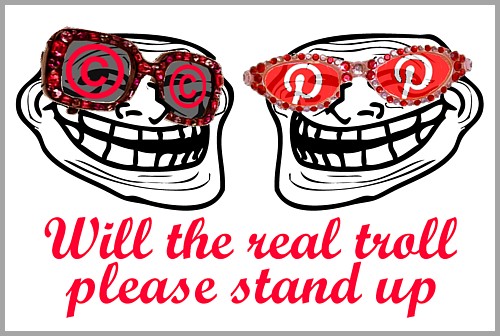
It's not clear who is trolling who.
This begs the question of why content creators don't ask for "reasonable" sums say, under a thousand dollars. Truth is, once they reach the exasperation point of sending cease-and-desist letters, they have already paid their attorney a sum that varies between $1000-1500. If they only want to strike fear in the hearts of infringers, and just break even, they need to ask for at least that amount. Typically, law firms will charge $150 per hour to negotiate with the infringing party. The content creator doesn't know ahead of time how much time will be spent in negotiations, therefore, the amount requested from the infringer will reflect this, and cover the risk, of at least a very conservative 5 hours of lawyer's time, propelling the demand in the $1750-2250 range. Now we need some negotiation headroom, doubling the amount to $3500-4500. Add the risk of further litigation, and the costs involved. Even if a court rules in the favor of the artist, some infringers simply don't have the ability to pay.
This is for an artist merely wanting to break even in the conflict; he'd be wise to ask for a little more, if only to avoid a deficit. Given all the risks, the economics of cease-and-desist letters require that the amounts asked be at least in the vicinity of $10,000 - most of which will go towards leather seats in the attorney's new BMW, and very little in the artist's pocket, if anything.
Next post: choosing appropriate recipients for cease-and-desist letters to send the strongest possible message to pinners that YES, they can be sued, and it's not cheap.

